A label is useful only when you can locate the boundary
Use your own material or an appropriate lawful reference. Identify where each section begins and ends with a bar, count or recognizable cue. A timestamp alone may become confusing when you change practice tempo. Do not reproduce copyrighted lyrics, melody or tablature in public logs without the needed rights.
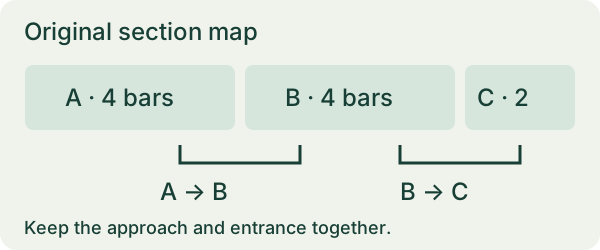
Fender’s song-structure overview describes labels such as intro, verse, chorus and bridge. Not every piece has the same sections or order. The A/B/C map below is an original exercise, not a transcription or a required structure.
Write what your part does at each join: rest, chord movement, picking change or rhythmic entrance. A comfortable chorus played after a reset may hide a problem in the preceding bar.
Worked map: A works alone, but A to B enters late
Fictional exercise: A has four bars, B four and C two. The meter is 4/4, the click is a quarter note and the subdivision is eighth notes. A four-beat count-in precedes the start. Use the actual meter and pickup in your material rather than copying these choices blindly.
| Join | Window | Observation | Next comparison |
|---|---|---|---|
| A → B | Last A bar and first B bar | B late after final rest | Same two bars at manageable pace |
| B → C | Last B bar and first C bar | Works alone, fails in sequence | Keep approach bar |
| A → B → C | Whole original sequence | Review each join | Record entrances separately |
At 60 BPM, one four-beat bar lasts four seconds here; the two-bar join lasts eight, excluding count-in. That arithmetic defines the example, not measured playing or a required tempo.
Write “B alone works; entry from A not reliable” if that is what happened. Do not mark the entire sequence mastered from an isolated success. The next comparison retains the approach and entrance.
Simplify while keeping the join intact
Choose a manageable pace. If you simplify an internal detail, write what changed, so a clean simplified attempt is not mistaken for proof of the full part. Retain the boundary you intended to investigate.
For each repeat, observe whether you kept count and entered at the intended point. A rest still occupies time; removing it changes the exercise. If you cannot describe the issue yet, record uncertainty rather than a perfect score.
Reinsert a useful short comparison into the longer sequence. If the join fails there, keep both observations: short window works, longer context not yet stable. The log supports a next choice; it does not grade playing automatically.
RiffSprint structures practice time, not song analysis
RiffSprint’s listing includes routines, timer/metronome, repertoire work, recent history and an on-device journal. Free users receive three generated-session shuffles per rolling week and seven days of journal history. Premium lists unlimited generation, full history/analytics, custom/saved routines, exercises and creator packs.
The listing explicitly says no microphone recording or AI-generated advice. It does not promise song upload, automatic section detection or audio looping of your song. Use this external map to choose the task, then supported app tools to structure the time.
We publish RiffSprint. The CSV is independent, not an automatic import. The parent short-practice plan allocates time; this guide targets entering and leaving sections without resetting between them.
If the method fits your task, explore RiffSprint’s listed features on an iPhone. Check current features and plans before downloading.
See RiffSprint for iOSDownload the free worksheet
Use the CSV in Numbers, Excel or a spreadsheet editor. Two original song-neutral rows and a blank row; no transcription, audio measurement or app import. Replace them with your own observations. The CSV is separate from the app and no email is required.
Questions answered
Should I repeat only the difficult section?
Include the approach and exit when they are part of the problem; isolated playing does not test entry.
Does the app identify sections in my audio?
No automatic song analysis or audio looping is established by the current listing.
What if there is a pickup?
Record the real pickup and count-in. This example is not a rule for every piece.
Continue with RiffSprint on iOS
Use the App Store listing to check compatibility, privacy information and current plan terms. A free download may offer paid features.
Download RiffSprint for iOSSources and product details
- Fender: Basic song structure explainedPrimary section-name context read October 17, 2026; the practice example is original.
- RiffSprint on the App StoreCurrent US App Store product description; checked October 17, 2026.
Editorial method: primary guidance, a current Apple listing, an original worked example and an independent critique. No search ranking, install or outcome result is claimed.